As Alabama prepares to introduce invisible security emblems on every ballot in the November 3 general election, questions remain about how the technology will be used, what protections it provides, and whether it addresses concerns about the accuracy of electronic vote tabulation.
Alabama Secretary of State Wes Allen has announced a new ballot-security measure intended to help election officials distinguish authentic ballots from unauthorized reproductions. Beginning with the November 3, 2026 general election, every Alabama ballot is scheduled to contain a security emblem invisible to the human eye and detectable only through specialized equipment.
The initiative, announced June 24, 2025, was described by Allen’s office as the first of its kind in the nation. According to the Secretary of State, the emblems were scheduled for initial use on absentee ballots during the May 19 primary and June 16 primary runoff, followed by implementation on all ballots in November.
The development introduces an additional potential safeguard into Alabama’s election process. But it also raises a fundamental question: Does authenticating a ballot provide meaningful assurance that the votes recorded on that ballot are counted accurately?
The answer depends on what the security system is designed to accomplish—and what independent verification procedures accompany it.
A New Layer of Ballot Security
According to the Secretary of State’s official announcement, Alabama worked with an unnamed ballot-printing vendor to develop the invisible-emblem system. Election Systems & Software (ES&S) has been documented as a ballot-printing provider for Alabama counties, but the Secretary of State’s announcement does not identify ES&S—or any other company—as the developer of the new emblems. Specialized detection equipment was to be provided to election officials in each of Alabama’s 67 counties.
The placement and design of the emblem will change with each election cycle, an approach intended to make unauthorized reproduction more difficult.
Allen described the initiative as a major advancement in election security.
“The implementation of this emblem system is taking our state’s election security to the highest level that it has ever been,” Allen stated in the June 2025 announcement.
The technology appears intended to help officials authenticate ballot materials. If properly implemented, an emblem that cannot be reproduced through ordinary copying could provide a means of distinguishing authorized ballots from reproductions lacking the required security feature.
However, the presence of an authentication feature does not establish how frequently it will be examined, who will conduct the examination, or what procedures will apply when an emblem cannot be verified.
Those operational details determine how effectively the feature can protect an election.
The Photocopied-Ballot Demonstration
The distinction between ballot authentication and vote tabulation is particularly relevant in light of a previously reported demonstration involving Alabama voting equipment.
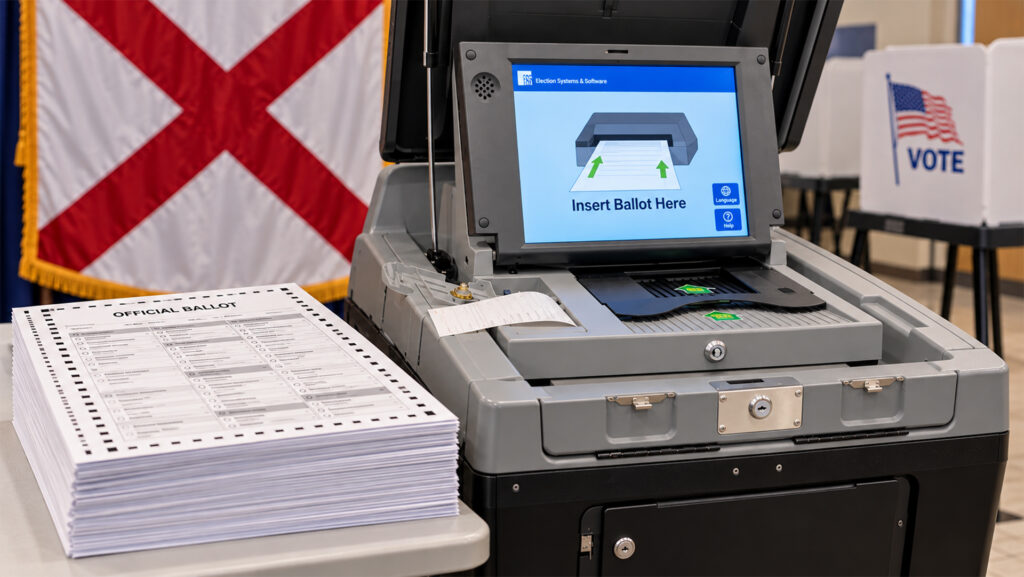
During a public voting-equipment test in Lee County in 2022, election-integrity advocate Angela Shepherd demonstrated that photocopies of her absentee ballot could be accepted and counted by an electronic ballot tabulator, according to multiple published accounts. A May 2026 report by The Observer states that all eight copied ballots were accepted and counted. Shepherd also described the demonstration in a March 2024 interview with 1819 News, explaining that she trimmed the photocopies to fit the machine before inserting them.
The demonstration raised questions about whether a tabulator could distinguish an officially printed ballot from an ordinary reproduction containing the machine-readable markings necessary for processing.
A tabulator’s acceptance of a photocopied ballot during a controlled equipment test does not, by itself, establish that unauthorized ballots were counted in an actual election. Nevertheless, the demonstration illustrates why ballot-authentication safeguards deserve careful examination.
Alabama’s invisible emblems may be relevant to precisely this concern.
If an ordinary photocopy cannot reproduce a valid emblem, and if election officials verify that emblem before accepting or counting the ballot, the system could provide an additional safeguard against unauthorized ballot reproductions.
But those conditions are essential.
A security emblem that is never checked cannot independently prevent an unauthorized reproduction from being processed by a tabulator.
The critical question is not simply whether an emblem exists, but whether Alabama has established and implemented a verification procedure capable of detecting ballots that lack it.
Important Questions About Implementation
An examination of publicly available information identified several operational questions that remain unanswered.
The Secretary of State’s announcement describes the planned implementation but does not specify whether every ballot will undergo emblem verification or whether officials will examine only selected ballots.
It also does not explain whether detection equipment operates independently of existing tabulators, whether authentication occurs before or after tabulation, or what happens when a ballot’s emblem is missing, damaged, or unreadable.
Other questions concern the equipment manufacturer, statewide program costs, county training, and the documentation maintained when ballots are examined.
Although the emblems were scheduled for use on absentee ballots during the 2026 primary and runoff elections, the public records examined for this article did not independently establish how the system was operated during those elections.
Likewise, the records located did not confirm county-by-county delivery of detection equipment or identify a statewide procedure requiring examination of every ballot before tabulation.
These unanswered questions do not establish that the system has failed or that counties lack the necessary equipment. They identify information needed to evaluate the program’s effectiveness.
The distinction matters because the practical value of a security feature depends on how it is incorporated into actual election procedures.
Ballot Authentication Is Not Vote-Count Verification
Even if Alabama’s new emblems successfully authenticate every ballot, another important election-integrity question remains.
Are electronic tabulators accurately interpreting and counting the votes marked on those ballots?
Ballot authentication and vote-tabulation accuracy address different concerns.
An authentication system may help determine whether a ballot possesses the required security feature. It does not independently establish that the tabulator correctly interpreted each voter’s selections, assigned votes to the appropriate candidates, or produced accurate totals.
Those questions require separate verification procedures.
Pre-election equipment testing can help establish that tabulators function correctly under controlled conditions. However, independently examining actual voted paper ballots after an election provides a different form of assurance: a comparison between voter-marked records and the results reported by the counting equipment.
This distinction is central to the argument for meaningful post-election hand-count audits.
Alabama’s New Audit Law Creates Another Opportunity
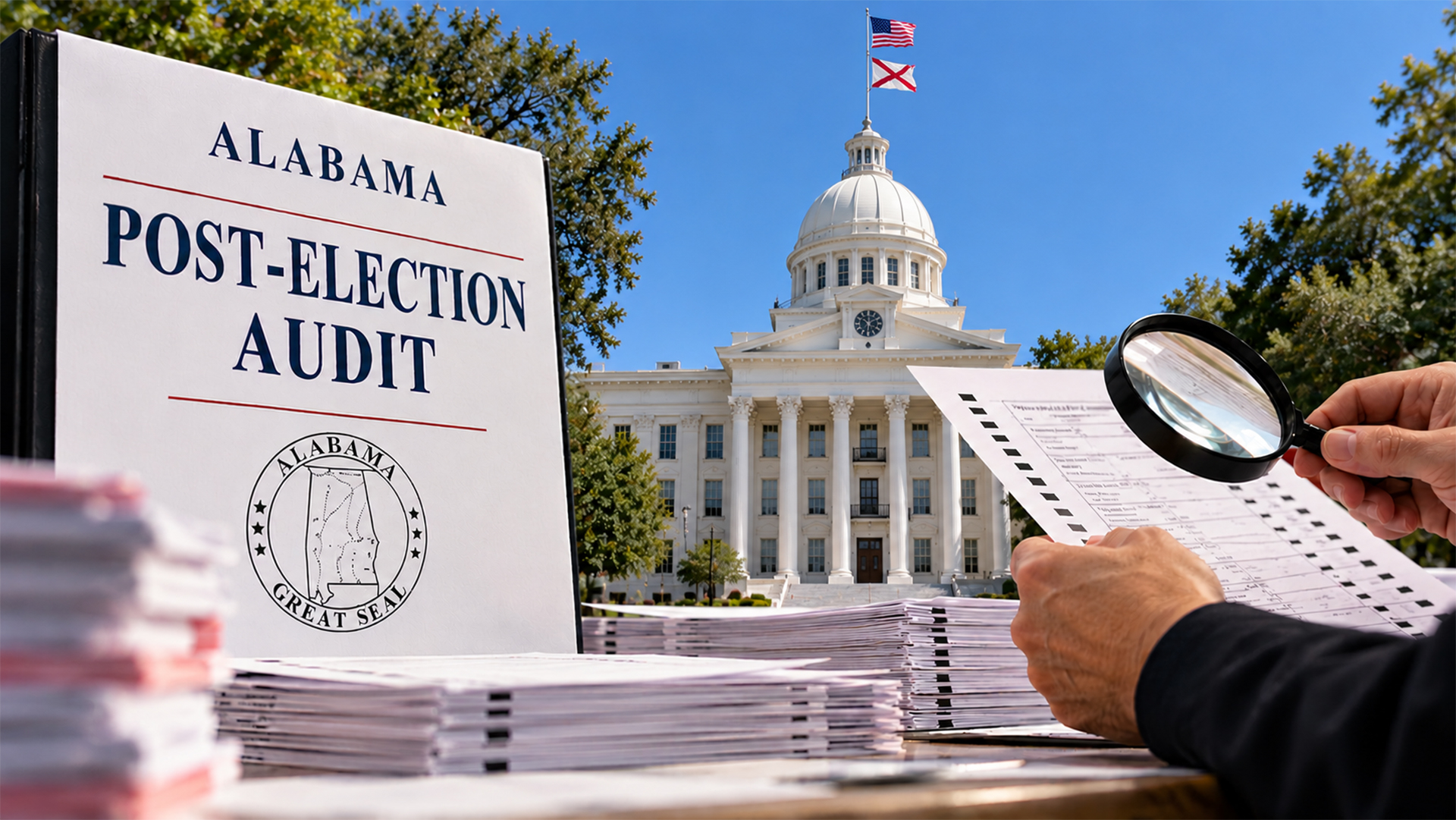
In April 2026, Governor Kay Ivey signed the Alabama Post-Election Audit Act, establishing a requirement for county-level audits following general elections.
Under the new law, each county must audit ballots from at least one selected precinct for at least one statewide or countywide race. Probate judges may authorize additional precincts and races.
Importantly, the law permits audits to be conducted through a manual tally or through ballot counters accompanied by a specified manual examination of at least 30 selected ballots.
That means Alabama’s new law allows independent hand-count audits but does not require a complete manual tally in every county.
The distinction is significant.
A full manual tally provides an independent comparison between the votes recorded on paper ballots and the results originally reported by electronic tabulators. Recounting ballots with electronic equipment, particularly when using the same technology, does not necessarily provide the same degree of independent verification.
The law therefore presents county probate judges with an opportunity to go beyond the statutory minimum and demonstrate the accuracy of reported results through more extensive hand counting.
November 13: The Next Investigative Milestone
The November 3 general election will provide the first scheduled statewide use of Alabama’s invisible security emblems on all ballots.
Ten days later, on Friday, November 13, 2026, at noon, county canvassing boards are required under the new audit law to select the precincts and races to be audited.
Probate judges must also determine the date, time, and location of their county audits.
This creates an important opportunity for public oversight.
The November 13 selections will begin to show which precincts and races counties intend to examine and provide a basis for determining whether probate judges authorize audits beyond the minimum requirement.
The audits themselves will take place later, according to the law’s timing provisions.
November 13 is not a required reporting date for the invisible-emblem system. Nevertheless, it represents an important milestone in the broader investigation of Alabama’s 2026 election-security measures.
StopVotingFraudAL.com intends to examine the county audit selections, the methods ultimately used to verify results, and any additional documentation that becomes available concerning implementation of the invisible-emblem system.
A follow-up report will examine what the evidence establishes after the election.
Election Security Requires Independent Verification
Alabama’s invisible security emblems may provide a useful additional protection against unauthorized ballot reproduction. Their effectiveness, however, depends on the procedures used to authenticate ballots and respond to irregularities.
The technology does not replace accurate voter rolls, secure ballot custody, transparent election procedures, or independent verification of vote totals.
Likewise, a post-election audit provides the strongest independent assurance of electronic tabulation accuracy when the voter-marked paper ballots are examined and compared with the originally reported results through a method that does not depend on the same counting process being evaluated.
The introduction of new security technology and mandatory post-election audits represents an opportunity for Alabama to strengthen public confidence through documented, verifiable procedures.
Whether that opportunity is fully realized will depend on implementation, transparency, and the willingness of election officials to provide meaningful independent verification.
Election security must be more than a feature on a ballot. It must be a transparent, verifiable process that citizens can trust.