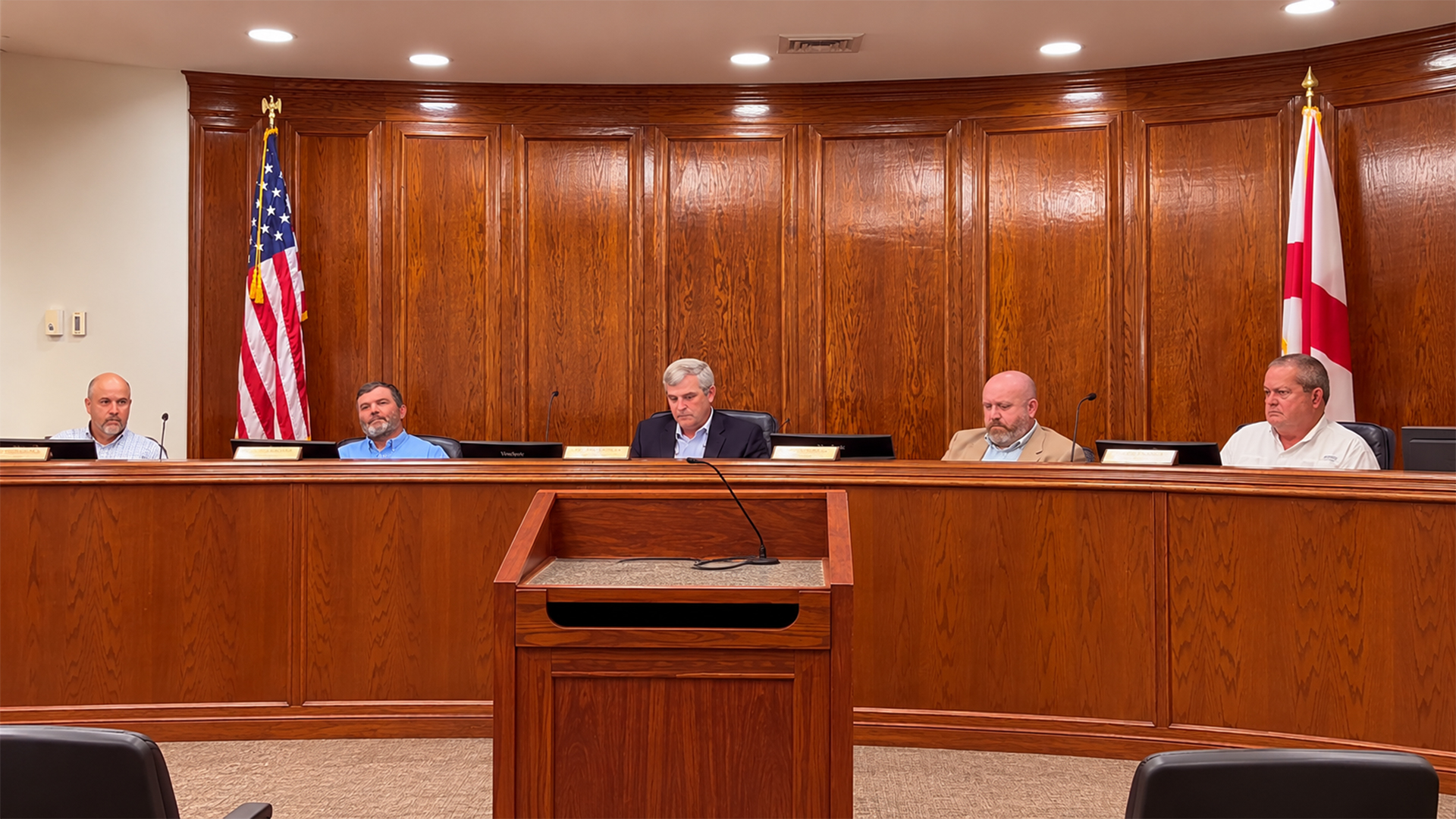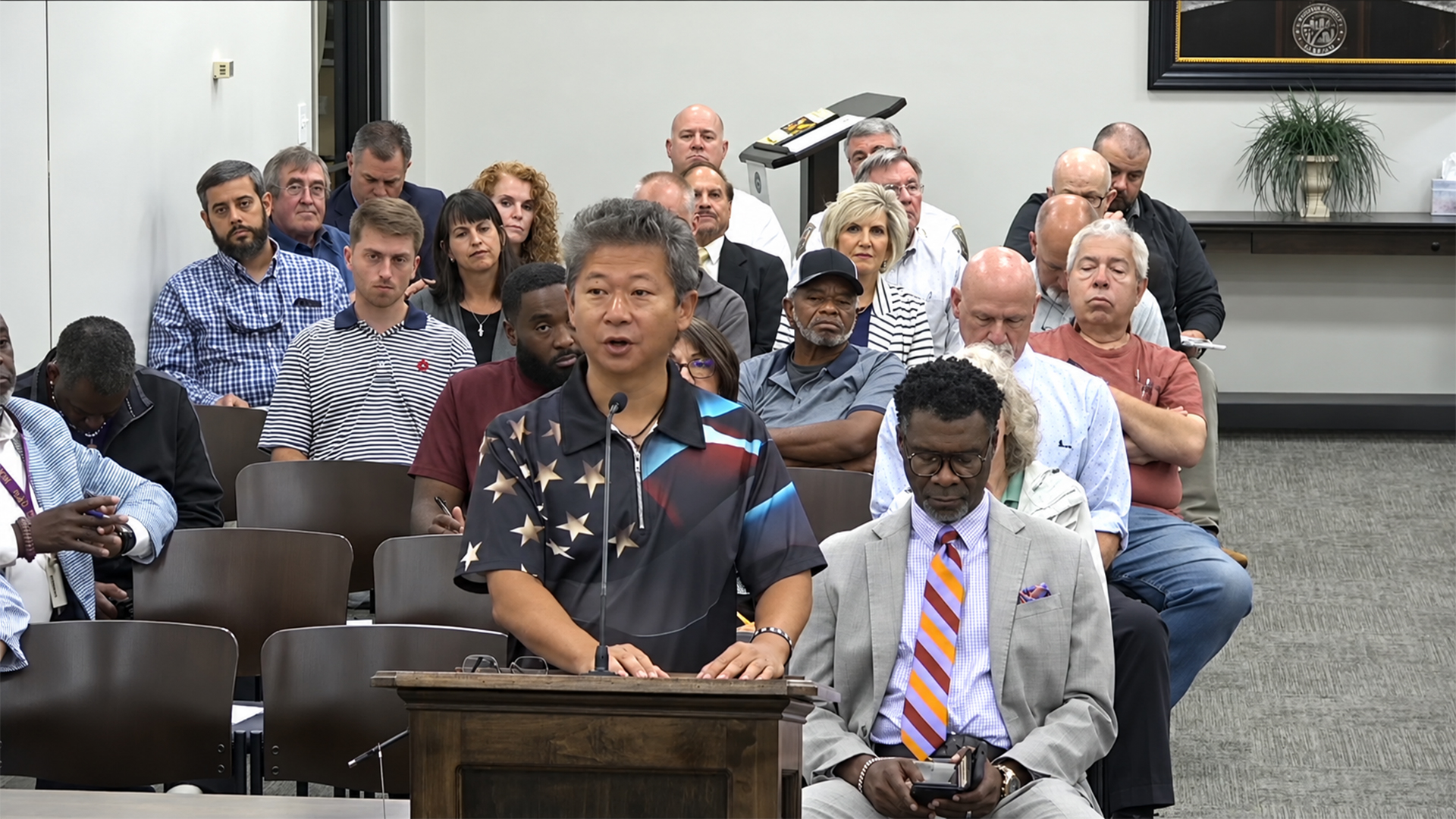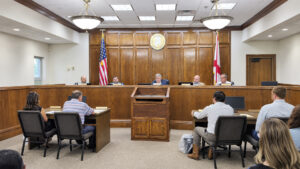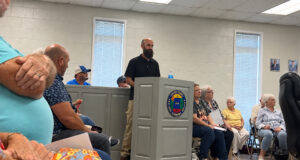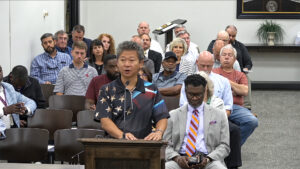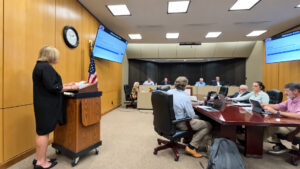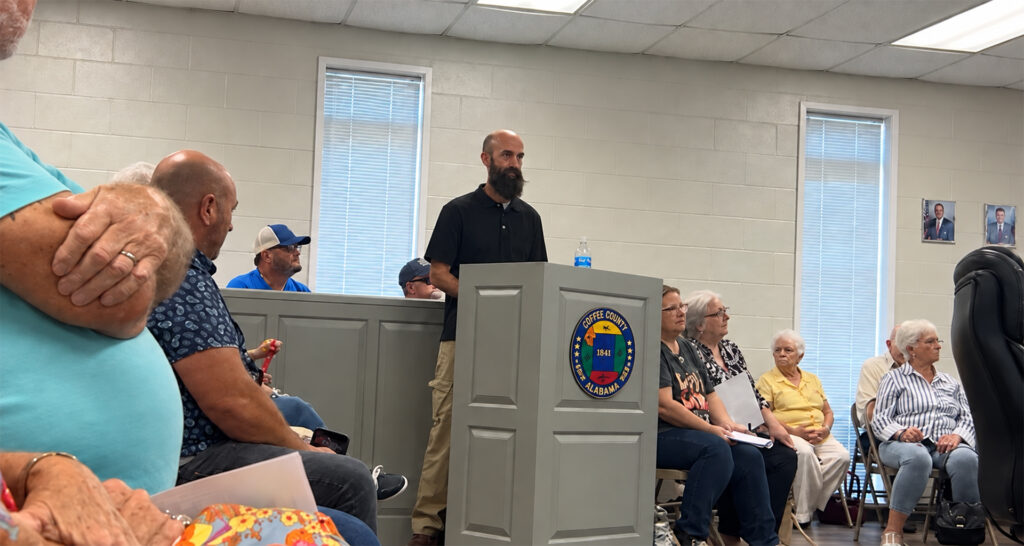
COFFEE COUNTY, Ala. — A seven-member team of Coffee County citizens brought months of voter-roll research before the Coffee County Commission on September 8, presenting findings that included deceased registrants, questionable addresses, apparent duplicate records, residency discrepancies, unusual registration dates and potential voter-eligibility issues.
Team member Joe Roughneen presented the findings from the group’s examination of Coffee County voter rolls from 2020, 2022, 2024 and 2025, which included cross-checking voter records against other publicly available information and, in some cases, door-to-door canvassing.
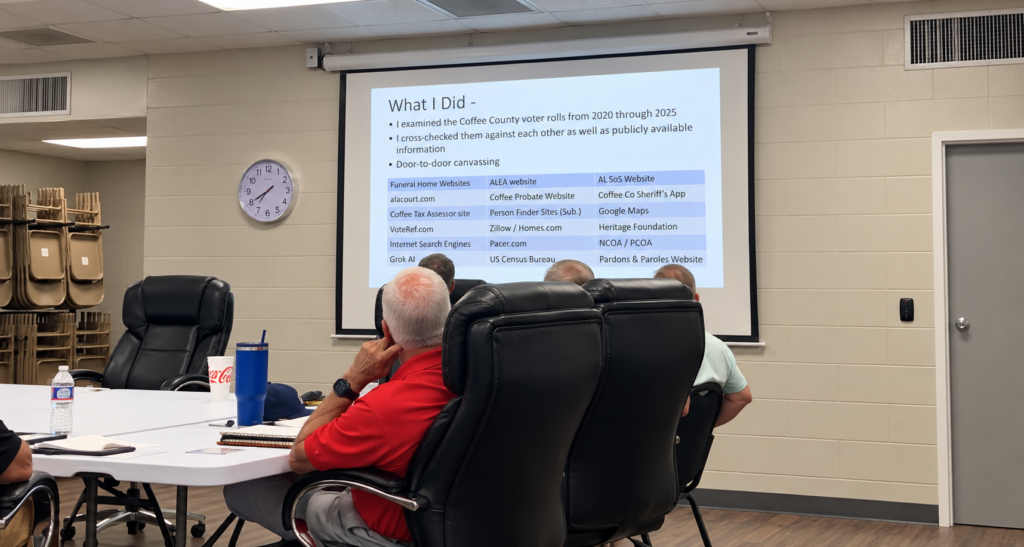
The Coffee County investigation is part of a broader county-level election-integrity effort underway in Alabama under the guidance of Dr. Douglas G. Frank. Citizen teams in multiple Alabama counties have been examining their own voter records and bringing their findings directly to local officials as part of Frank’s work with citizen groups across the country.
Coffee County now joins Morgan, Shelby, Walker and other Alabama counties where citizens have taken that research before county government.
Roughneen began by placing the Coffee County investigation in the context of election-integrity developments occurring at both the state and national levels. Among them was Alabama Secretary of State Wes Allen’s January 2026 announcement that his office had used the federal SAVE system to identify 186 noncitizens registered to vote in Alabama, including 25 with voting histories. A subsequent county breakdown identified four of the 186 registrations in Coffee County.
The Coffee County team attempted to obtain additional information about those four registrations as part of its research.
But the team’s investigation went considerably further, examining multiple categories within Coffee County’s own voter records.
Dr. Frank’s Analysis Identified a 6,000-Registration Discrepancy
One of the foundations for the Coffee County investigation was Dr. Frank’s mathematical analysis of the county’s voter-registration data.
Frank compared Coffee County’s registered-voter population by age with the county’s population trend. His analysis calculated approximately 6,000 more registered voters than the population trend would predict, out of roughly 39,000 registrations.
During the presentation, a commissioner stopped Roughneen to clarify the number.
“You’re talking about just Coffee County?” the commissioner asked.
“Just Coffee County,” Roughneen replied.
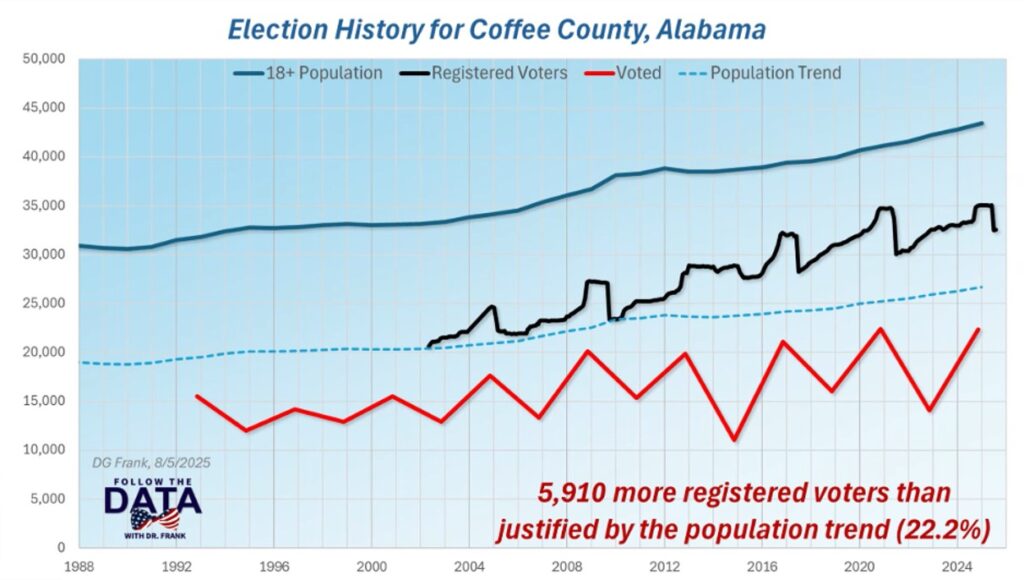
Dr. Douglas G. Frank’s Coffee County voter-registration analysis comparing the county’s population trend with registered-voter totals.
Frank’s analysis looks at registration patterns across the population. The Coffee County team approached the issue from another direction: examining individual voter records to determine what could be found inside the county’s voter rolls.
What the team found covered multiple categories.
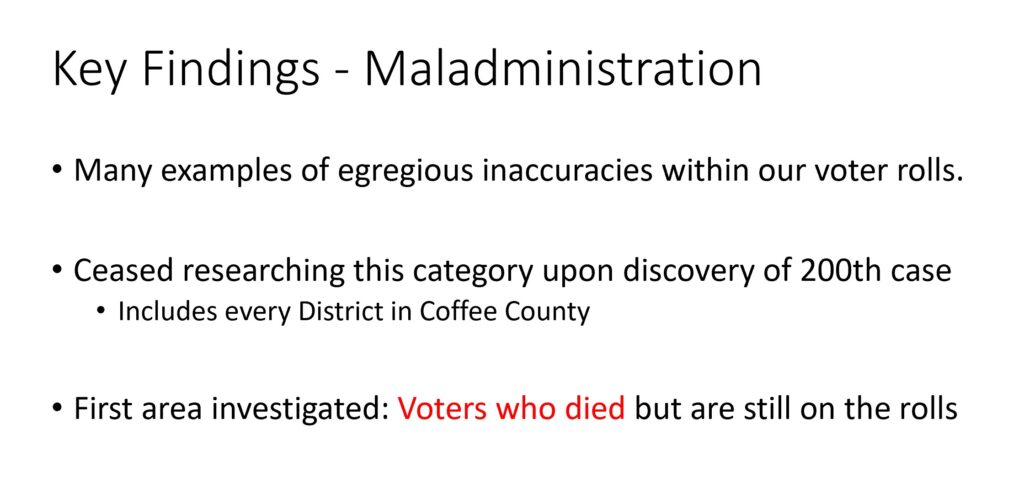
Team Stops One Category After 200 Cases
Among the records presented to commissioners were deceased individuals who remained on Coffee County voter rolls years after their deaths.
The examples included registrants who died in 2001, 2010, 2013, 2014, 2015, 2016, 2017, 2018 and 2019, with records continuing to appear on later voter rolls.
The team also found registrations associated with vacant lots in Enterprise and commercial properties, along with incomplete addresses and other address discrepancies.
Some records contained registration dates that were chronologically impossible. Examples presented to commissioners included a person born in 1964 with a registration date of 1908, another born in 1961 with a registration date of 1921, and another born in 1947 with a registration date of 1927.
The team also documented apparent duplicate records involving two voter identification numbers and matching or closely corresponding names, birth dates and addresses.
Roughneen grouped those and other voter-roll problems into a broader category the presentation identified as “maladministration.”
The team eventually stopped researching that category after documenting its 200th case. At that point, Roughneen explained, the team believed it had documented enough cases to demonstrate the extent of the problem and moved on to other areas of the investigation.
Residency and Eligibility Questions
Residency produced another substantial group of findings.
The team examined a 2022 National Change of Address list containing approximately 200 Coffee County records. Roughneen reported that 99 percent of those records were still present on the county’s 2025 voter rolls.
The investigation then compared voter-registration and voting-history information and identified examples of people who had moved and registered elsewhere while remaining on the Coffee County rolls. Roughneen also presented records showing voting activity in another jurisdiction while the individual remained associated with Coffee County.
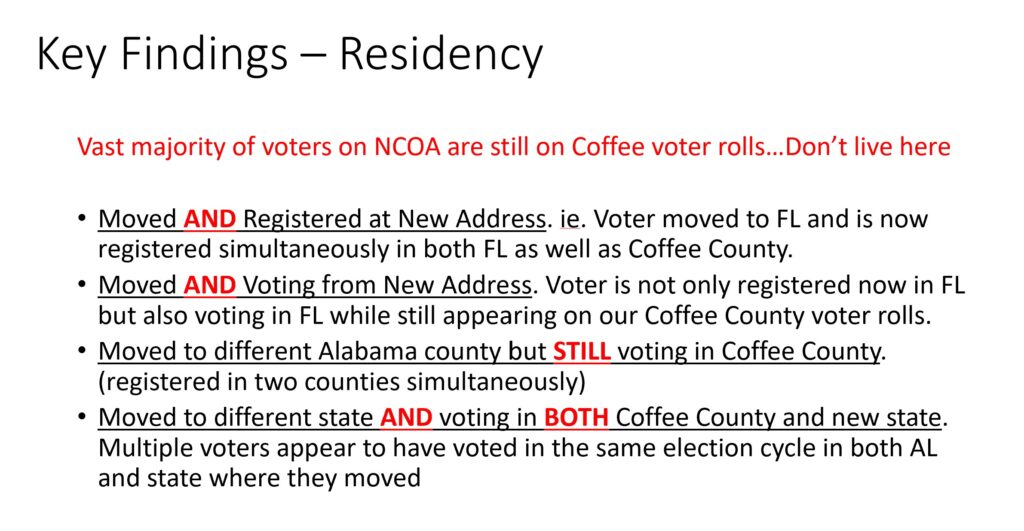
Coffee County National Change of Address findings from the team’s presentation.
Other portions of the investigation focused on voter eligibility.
The team reported records showing voting histories that appeared to predate the voter’s 18th birthday. It also identified individuals with felony convictions who remained on subsequent Coffee County voter rolls, including cases the team believed involved convictions for crimes of moral turpitude.
Determining whether a particular person with a felony conviction was legally eligible to vote requires consideration of the offense and any subsequent restoration of voting rights. The records were presented to commissioners as cases the team believed warranted examination.
The team also examined records involving individuals placed under guardianship for reasons of mental impairment or mental illness. Roughneen noted that, under the Alabama Attorney General guidance he cited, a guardianship order must deem the individual mentally incompetent and specifically remove the person’s voting rights.
The team found individuals with serious documented mental conditions who remained registered to vote, and Roughneen said many had voting histories extending beyond the dates of the judges’ orders.
“My contention these people aren’t even voting,” Roughneen told commissioners. “I think they’re being taken advantage of.”
Roughneen acknowledged that the team could not determine from the voter-roll data whether those votes were cast absentee and presented the issue as one warranting further investigation.
Taken together, the findings led Roughneen to a straightforward conclusion about the condition of the records the team had examined: Coffee County had enough unresolved voter-roll issues to justify a deeper investigation into both the records and the system responsible for maintaining them.
“These Are All Coffee County”
During the question-and-answer period, one commissioner began recapping what he had heard.
The findings involved people who appeared too young to have voted, felony convictions, deceased registrants, questionable residences and mental-incapacity issues.
Then he asked Roughneen for clarification.
Were these examples actually from Coffee County?
“These are all Coffee County,” Roughneen replied.
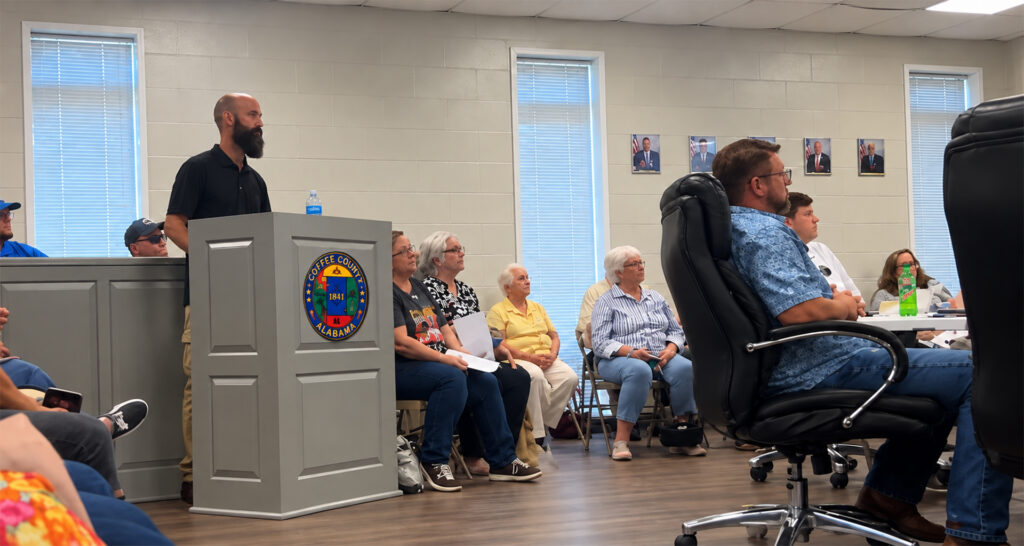
That exchange brought the discussion back to the central purpose of the citizen investigation. The presentation was not simply about election-integrity concerns elsewhere in Alabama or around the country. The seven-member team had examined Coffee County’s own records.
At the same time, Roughneen made clear that the team was not blaming Coffee County poll workers, election workers or current local officials for the problems it found. He praised the people who conduct local elections and agreed with commissioners that local officials had inherited a complex system.
The question, he said, was how to identify the source of the problems and determine what could be corrected.
Coffee County Becomes Part of a Growing Alabama Effort
The Coffee County presentation follows similar citizen research being conducted elsewhere in Alabama.
Citizen teams have brought voter-roll findings before officials in Morgan, Shelby and Walker counties, with other county teams also conducting research. Although the specific findings differ from county to county, the approach is consistent: citizens obtain voter records, examine the data, document what they find and take the results to the officials responsible for their local elections.
The county-level work is part of the broader election-integrity effort guided by Frank, who has worked with citizen groups examining voter-registration data across the country.
In Coffee County, that larger effort produced something very local: seven county residents examining their own voter rolls and asking their own county officials to help determine why the records contain the problems they documented.
Commissioners Discuss a Special Work Session
As the presentation moved into questions, commissioners increasingly focused on what Coffee County could legally and practically do next.
One commissioner asked what authority the Commission actually has over the voter rolls and election process.
Roughneen did not present himself as having all of those answers.
“I’m not the expert,” he told commissioners. “I fly helicopters.”
Instead, he urged the county to bring people with election, legal and technical expertise together for a more extensive work session where the findings and the underlying systems could be examined in greater depth.
The discussion included Alabama cybersecurity specialist Clay Parikh, whose professional background includes cybersecurity and voting-system testing. Roughneen raised the possibility of involving Parikh or other technical experts in a future session.
No additional Coffee County work session was formally scheduled during the September 8 meeting, but commissioners expressed support for continuing the discussion.
“I think that we should do a special session, because it’s way too complex to cover in 35 minutes,” one commissioner said.
Another responded, “I would support a special session.”
Near the end of the discussion, Roughneen emphasized that the citizen investigation was not intended to target individual voters. The team withheld personal identifying information during the public presentation, and Roughneen acknowledged that some individual records could ultimately have explanations that were not apparent from the data alone.
The objective, he said, was to determine what was actually happening.
“I think we have enough issues, so we should get smart people in the room to find out what’s true and what’s not.”
His final point summarized both the Coffee County investigation and the larger county-level effort behind it:
“Let’s just find out what the truth is.”
Watch the Coffee County team’s full presentation and discussion with the Coffee County Commission below.