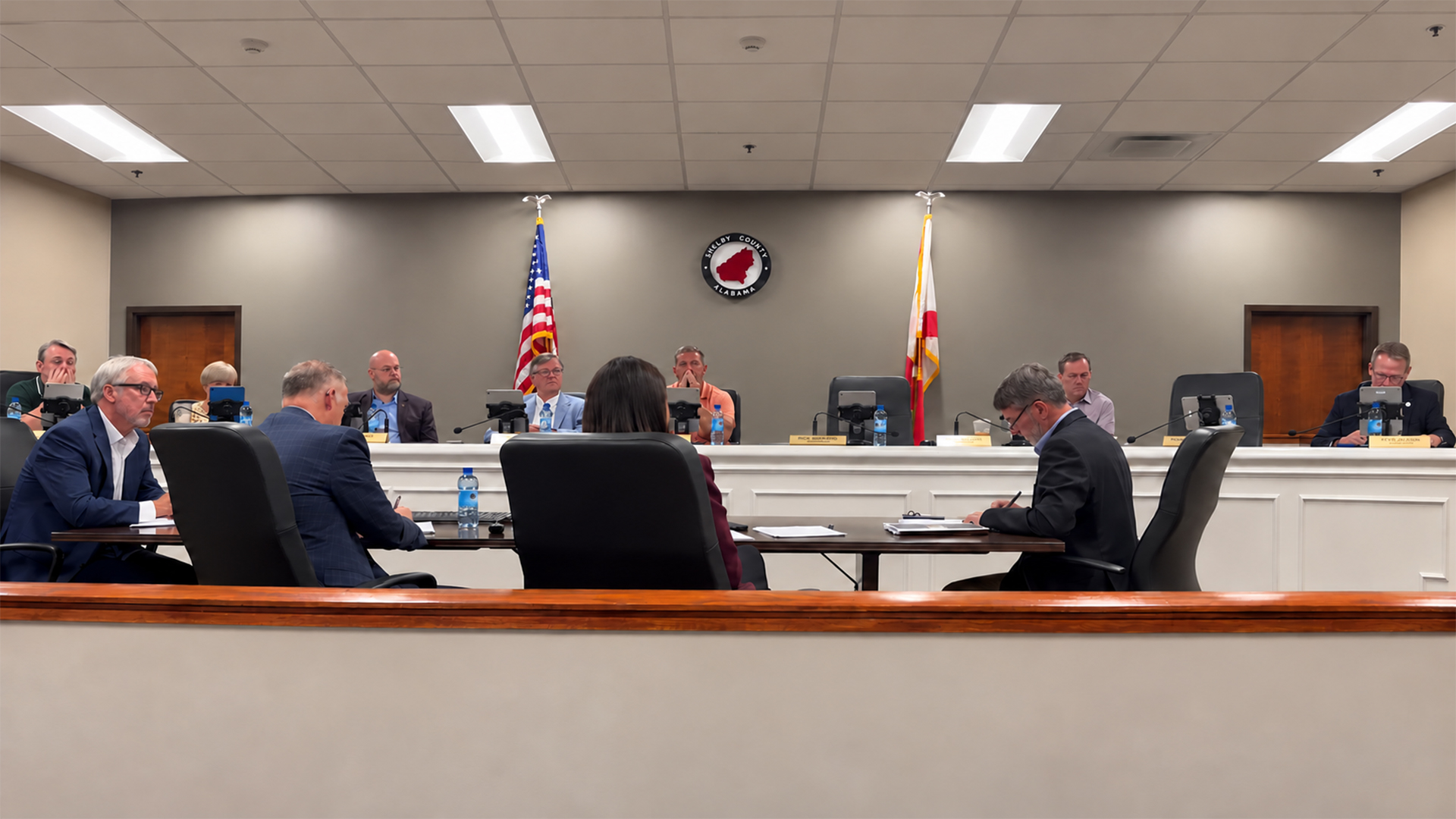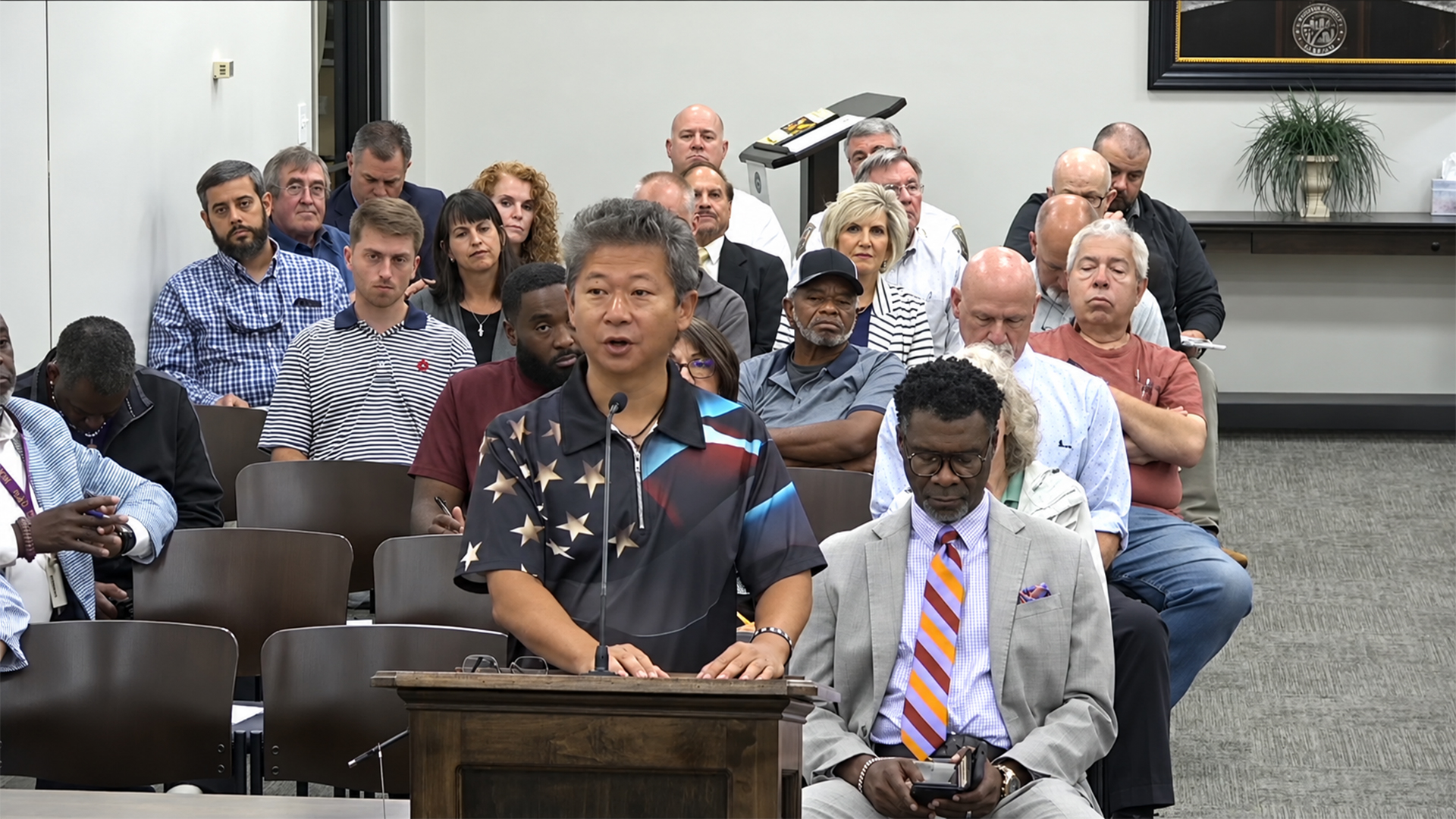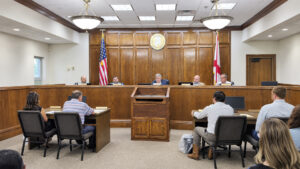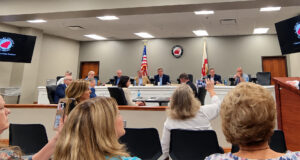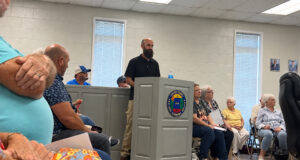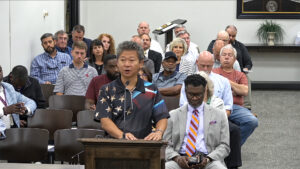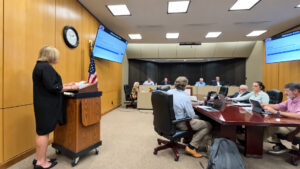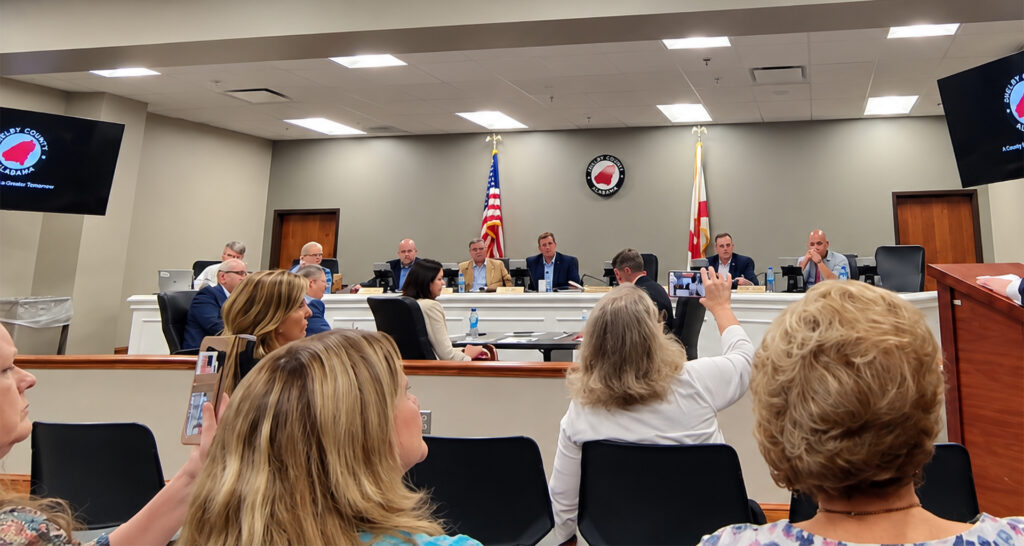
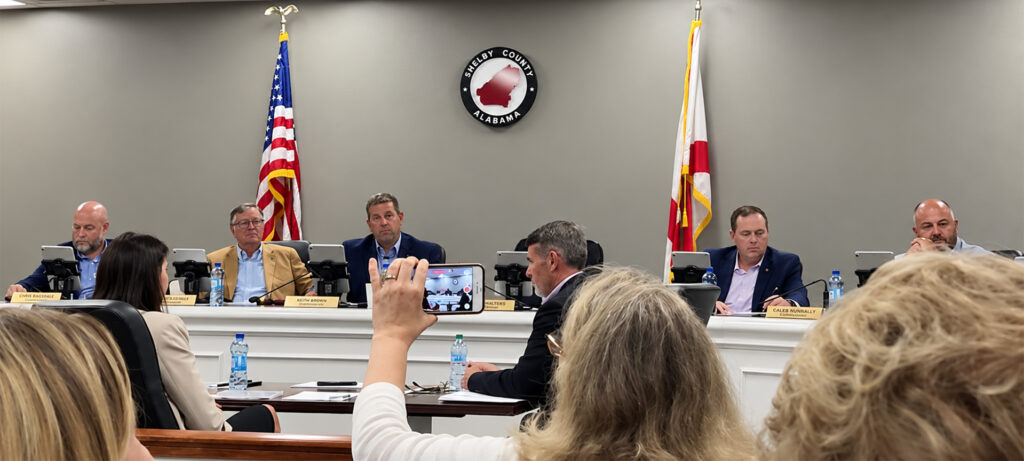
SHELBY COUNTY, Ala. — Shelby County citizens presented documented voter-roll findings to the Shelby County Commission on August 24, raising concerns involving deceased registrants, voters who had moved, registrations that remained active despite years without voting activity, voter eligibility following felony convictions, noncitizen registrations and the broader administration of Alabama’s voter-registration system.
Four speakers addressed the Commission: Joy Stritikus, Mike Rector, Phaedra Galloway and Dr. Douglas G. Frank. Their presentation combined specific findings from Shelby County voter records with concerns about the state system local officials are required to use.
Stritikus opened by emphasizing that the group’s concerns were directed at the system rather than Shelby County’s Board of Registrars.
“The voter rolls are the responsibility of the Board of Registrars, who are very conscientious,” Stritikus told commissioners, describing registrars as working within a system that does not provide all the tools they need to maintain current and accurate voter rolls.
She said the existing system does not adequately help registrars identify categories requiring attention, including deceased individuals, people who have moved, noncitizens and individuals who have not voted for the period prescribed by law.
Stritikus also raised concerns about public access to voter-registration records and the cost citizens must pay to obtain them. She argued that limited access makes independent examination of the voter rolls more difficult and reduces transparency.
“The lack of transparency raises questions and further erodes the public trust,” she said.
Deceased and Moved Voters
Mike Rector then presented specific records identified during the Shelby County team’s research.
Rector first cited a Department of Homeland Security report stating that Alabama’s work with the federal SAVE system had identified 33,165 deceased registrants.
He then presented a Shelby County example involving a woman who lived in a Pelham nursing home. According to the records presented, she registered in Shelby County in 2002 and voted in every general election from 2014 through 2020. An obituary record showed that she died December 3, 2023, at age 97, yet she remained listed as an active Shelby County voter as of August 21, 2026.
Rector next presented two examples involving individuals who had moved.
The first involved an individual who moved from Alabaster to Daphne, Alabama, effective January 1, 2023. The records showed subsequent voting activity by absentee ballot in 2024. Rector said the registration was only recently changed to inactive status pending the confirmation-mailing process.
The second involved an individual who moved from Maylene to Bronx, New York, effective August 1, 2022. The Shelby County records nevertheless reflected voting activity in the 2022 and 2024 general elections. Rector reported that neither election was recorded as an absentee vote and that the registration remained active as of August 21, 2026.
“How did case number two vote in 2022 and 2024 after moving if it was not by an absentee ballot?” Rector asked commissioners.
The finding does not identify who was responsible for the recorded voting activity. It does, however, establish a discrepancy requiring an explanation: Shelby County’s records reflected voting activity associated with a registration after the individual had moved out of state, while the registration continued to be carried as active.
181 Registrations Remained Active
Phaedra Galloway presented additional results from the citizen team’s review.
Among the findings were 181 voters who remained listed as active despite having no recorded voting activity since before 2014.
That finding is significant because Alabama law expressly addresses prolonged periods of voter inactivity. Alabama Code §17-4-9 provides that a voter who fails to vote for four years in his or her county shall have his or her name placed on the inactive voter list.
In other words, inactive status after the statutory period is not merely an administrative preference—it is part of Alabama’s voter-list-maintenance law. The 181 records presented by the Shelby County team remained classified as active despite exceeding that four-year period.
The full text of Alabama Code §17-4-9 is included in the Media & Documents section below.
Felony Eligibility Findings
Galloway also reported that the team identified seven individuals convicted of sex crimes falling within Alabama’s moral-turpitude provisions who remained registered and had voting activity recorded after their convictions. Four of the seven convictions occurred outside Alabama.
Alabama law specifically defines which felony convictions constitute moral turpitude for purposes of voting eligibility. Alabama Code §17-3-30.1, the Felony Voter Disqualification Act, establishes the offenses that result in voter disqualification.
The law also accounts for qualifying convictions under the laws of other jurisdictions. That is important to the Shelby County findings because four of the seven cases presented involved convictions outside Alabama.
A conviction alone does not establish that subsequent voting activity was improper if the individual’s voting rights had legally been restored. Restoration-of-rights status therefore must be considered when evaluating an individual case.
The full text of Alabama Code §17-3-30.1 is included in the Media & Documents section below.
Galloway also raised concerns about the availability of records involving adjudications of mental incapacity and cited Alabama Secretary of State findings identifying five non-U.S. citizens registered in Shelby County.
The team’s research produced one positive finding as well: Galloway reported that the review found no underage registrants in Shelby County.
“Accurate voter rolls are the basic foundation of free and fair and transparent elections,” she told commissioners.
Dr. Frank Calls for Local Control
Dr. Douglas G. Frank concluded the presentation by placing the Shelby County findings within a broader effort underway in Alabama.
Frank said citizen teams are examining voter rolls in counties across the state and bringing documented findings before local officials. He urged Shelby County to consider restoring greater local control over its voter-registration records rather than depending exclusively on the state’s existing system.
Frank told commissioners that his objective is to continue providing county officials with documented cases so they have evidence on which to evaluate the system and determine what action should be taken.
“What matters to me is evidence and hard documentation of what we’re doing,” Frank said.
He also offered his assistance to Shelby County without charge, telling commissioners that tools are available to help counties maintain more accurate voter rolls locally.
“We’re going to bring that to you because we need to empower you,” Frank said. “We’re going to give you the actual evidence that empowers you to take the stand that you need to take.”
Watch the full voter-roll presentation to the Shelby County Commission below.
The Shelby County presentation is part of a growing county-level effort in Alabama in which citizens are examining official voter-registration records, documenting discrepancies and placing their findings into the public record before local government officials.
The Shelby County team’s findings also illustrate why voter-list maintenance involves more than the number of names appearing in a database. When official records continue to classify voters as active beyond statutory maintenance periods, retain deceased registrants, or reflect voting activity associated with registrations after documented moves, those records raise questions about whether the system is performing the safeguards required of it.
For the citizens who addressed the Commission, the objective is to put those findings before the officials responsible for county government and provide the documentation necessary for those officials to act.
StopVotingFraudAL.com will continue following the Shelby County effort and any response or action resulting from the evidence presented to county officials.