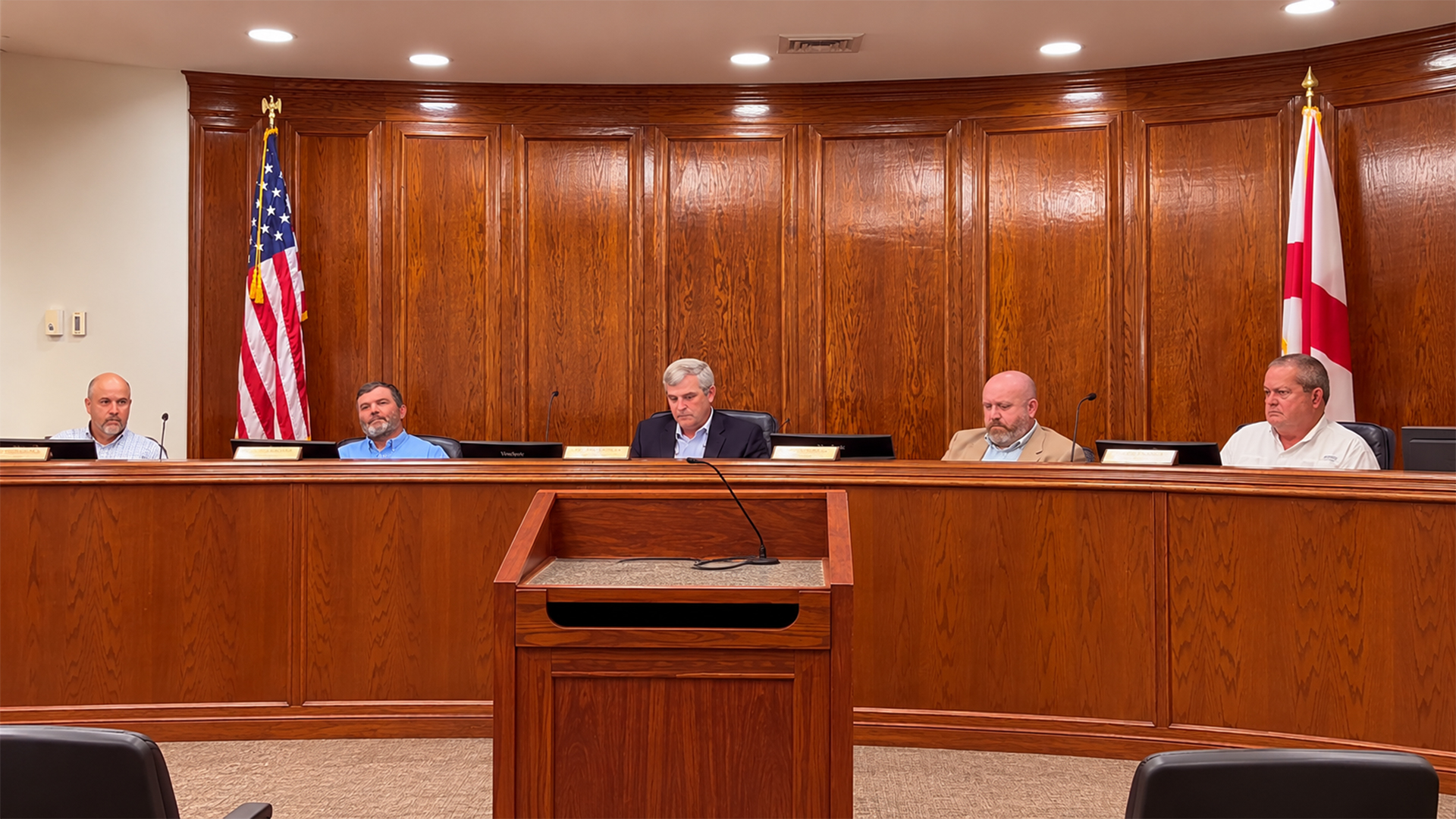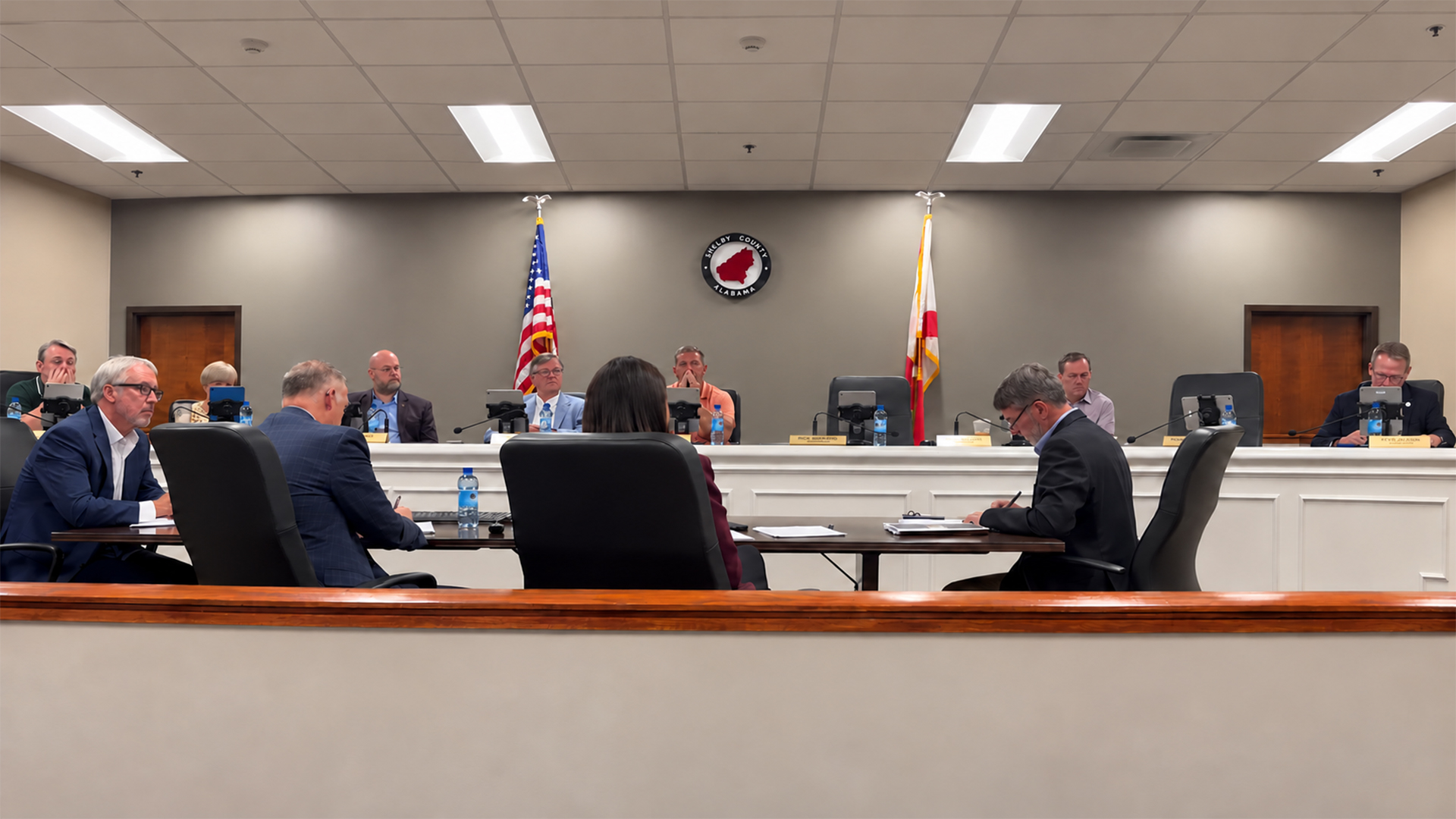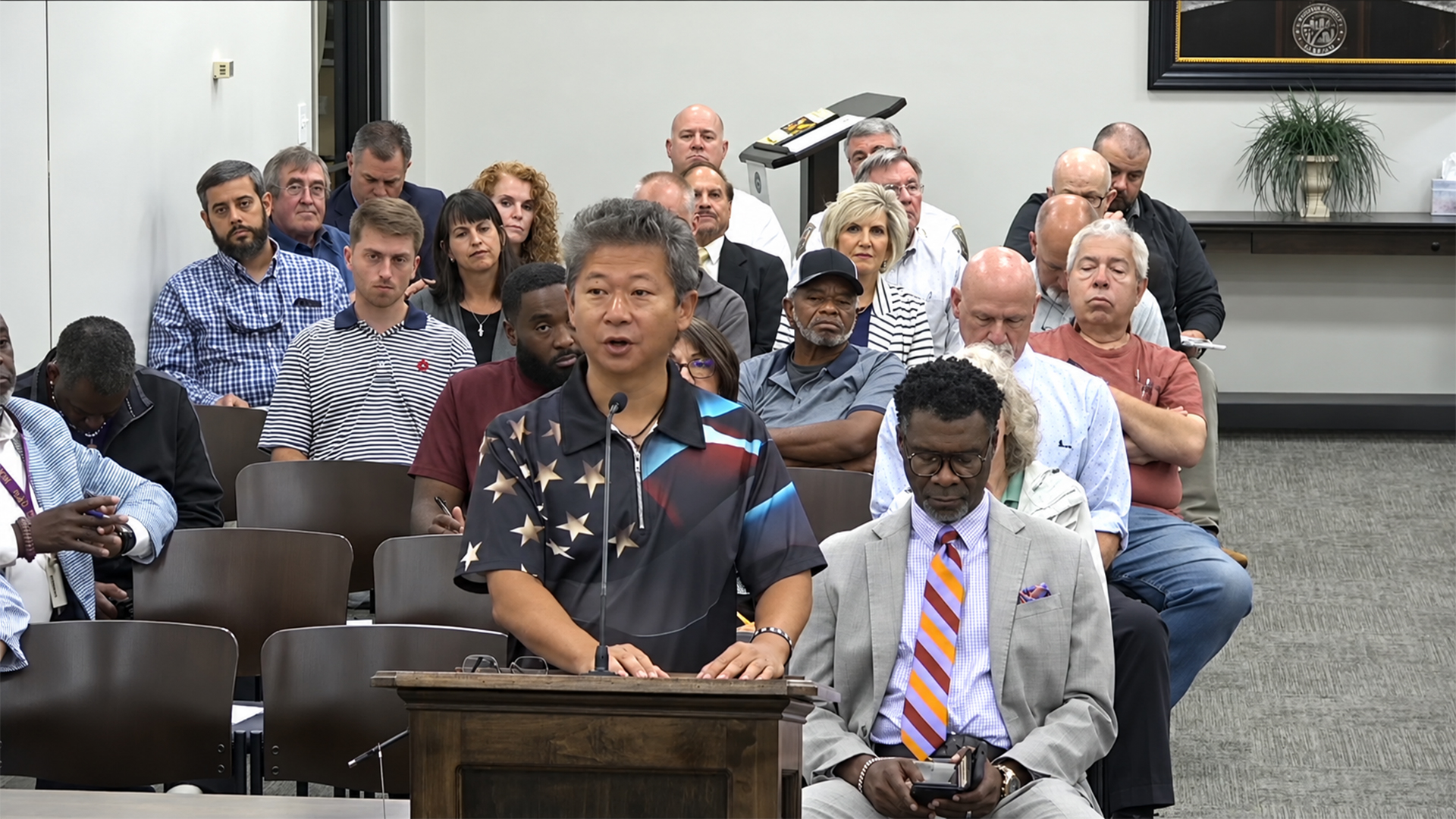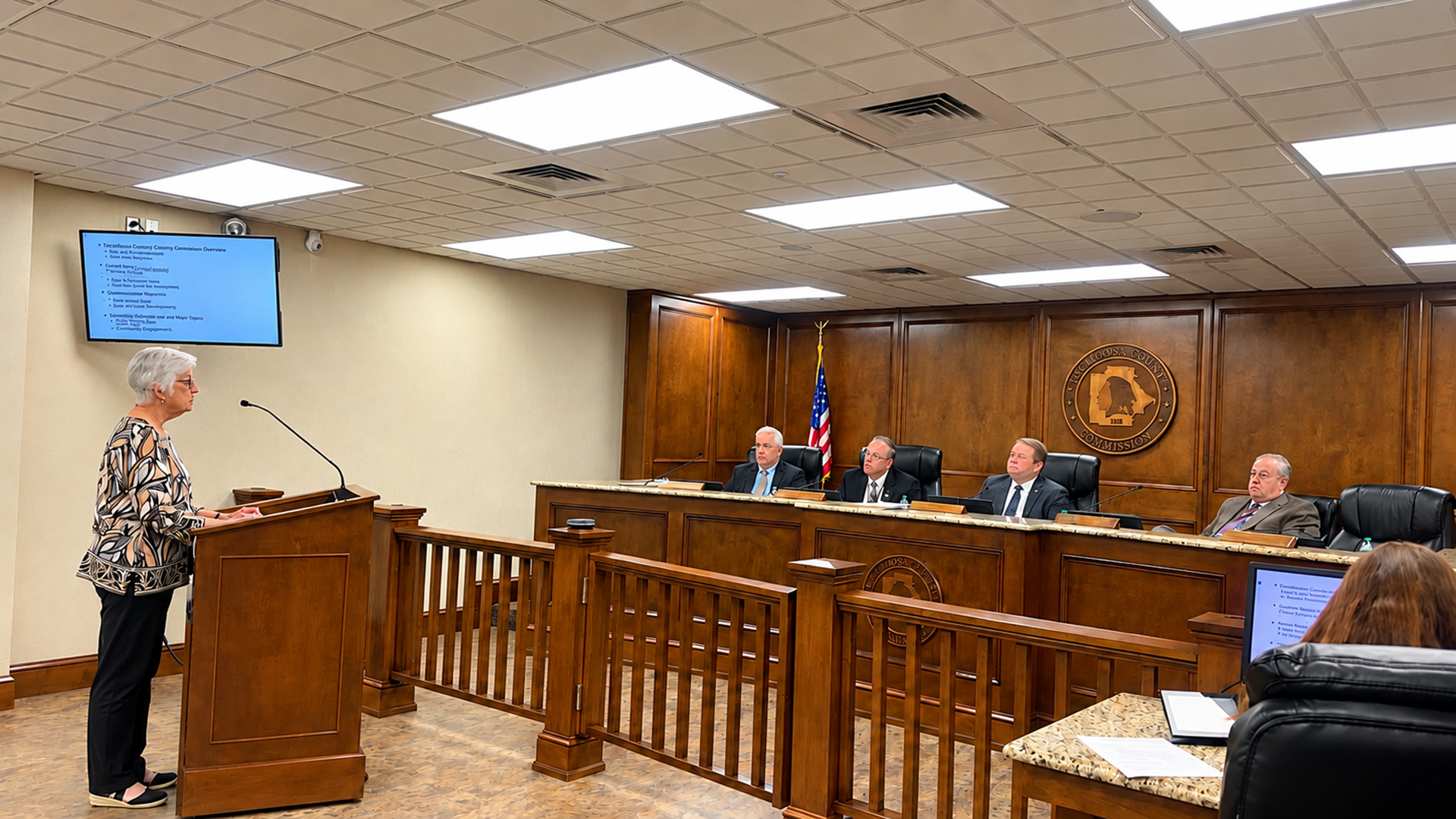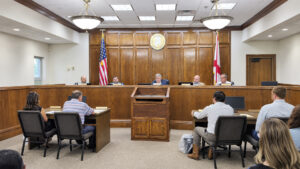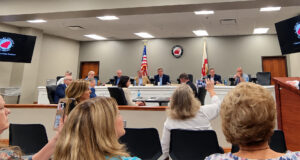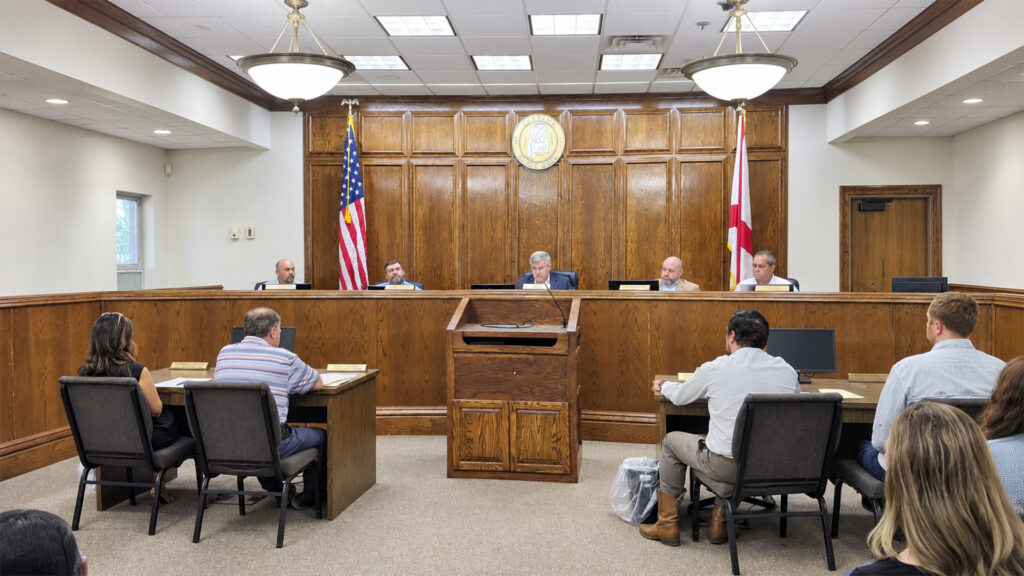
After seven months of research into Autauga County voter records, a local citizen election-integrity team presented its findings to the Autauga County Commission on September 15, documenting deceased individuals who remained active on the voter rolls for years, registrations tied to non-residential addresses, noncitizen registrations, convicted sex offenders the team found were ineligible to vote, and voting-history records associated with voters outside their registered precincts.
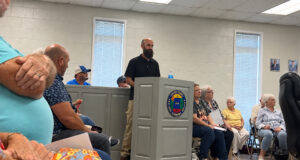
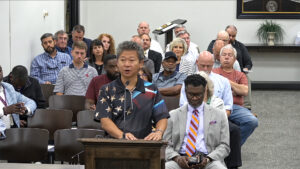
The presentation was delivered by Wil Sanchez, Ted Halley, Lori Herring and Sarah Sanchez, with each addressing a different part of the investigation. The team’s research went beyond computerized searches of voter-roll data. Members examined death records, criminal and court records, property and residency information, voting histories and physical addresses, with Halley telling commissioners he had spent hundreds of hours reviewing records and driving throughout the county to investigate individual cases.
The investigators did not publicly display the names or complete voter-registration information during the Commission meeting. Instead, the presentation used abbreviated voter identifiers to protect identifying information in a public setting.
Wil Sanchez opened by describing the scope of the work.
“We’ve spent countless hours over the past seven months analyzing thousands of data entries,” Wil Sanchez told commissioners.
He said the investigation led the team to four overarching conclusions concerning Alabama’s voter-registration system, including failures of state and federal compliance identified by the team and a loss of meaningful local control over voter records. The presentation then moved from those broader conclusions to the evidence the team had gathered in Autauga County.
Deceased voters remained active for years
Halley presented examples of deceased individuals whose registrations remained active long after their deaths.
One registrant, identified publicly as voter #287, died in 1998 but remained classified as an active voter until 2020—approximately 22 years after death.
Another, voter #440, died in 2010 but remained active through 2024. The registration was later changed to inactive status and ultimately removed in 2026. Had that individual still been living, the voter would have been approximately 125 years old.
The fact that those registrations were eventually removed does not eliminate the election-integrity concern created during the years they remained active. A voter roll is intended to identify people eligible to participate in an election. When the registration of someone known to be deceased remains active for years—or decades—the system continues to carry an active registration for a person who can no longer lawfully use it.
That creates a vulnerability: an active registration belonging to a deceased person can potentially be used by someone else to obtain or cast a ballot in that person’s name. The Autauga cases presented by Halley documented prolonged failures to remove deceased registrants, leaving that opportunity for misuse in place for as long as the registrations remained active.
Halley also acknowledged that the state appears to have improved its removal of deceased voters in more recent records.
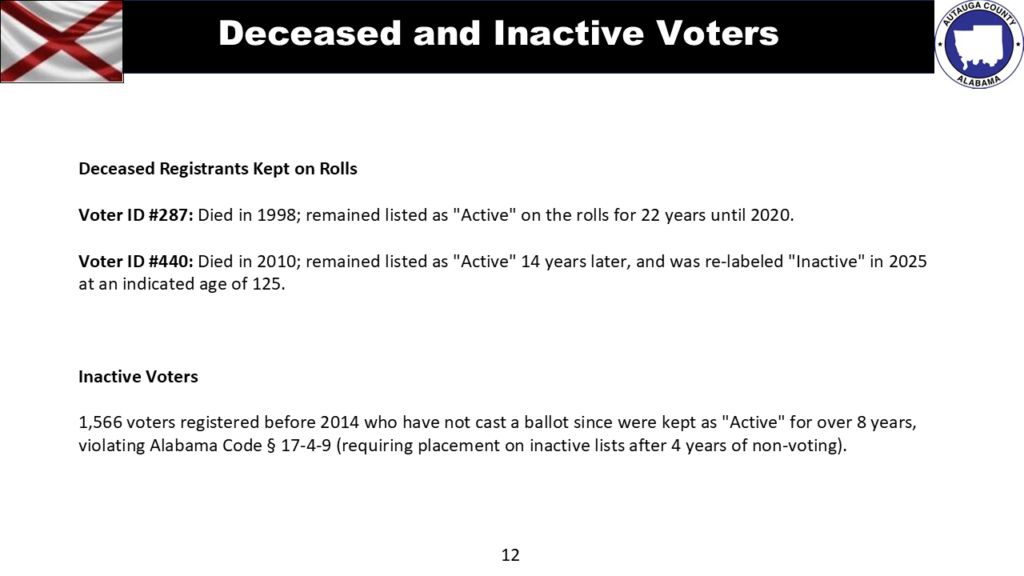
The investigation also identified 1,566 voters who had remained classified as active since at least 2014 despite having no recorded voting history. Halley connected those records to Alabama’s voter-list maintenance requirements and questioned why the registrations had continued to carry active status for so many years.
Registrations tied to non-residential addresses
The team also investigated registrations associated with addresses that did not appear to be legitimate residences.
Among the examples presented was voter #3154, whose registration used a post-office address. The voter registered and voted once in 2016 and was later classified as inactive.
Another, voter #0404, was registered from a business address, had no recorded voting history and remained active.
Voter #789 was associated with an address the investigators found to be a vacant lot. That voter had a recorded vote in 2008, remained active until 2020 and was later changed to inactive status.
These findings matter because a voter’s residence determines where that person is entitled to vote and which local races, districts and ballot questions apply. The investigation therefore went beyond identifying unusual-looking addresses in a database. Team members researched the locations themselves and compared the registration records with the actual properties.
State and federal reviews identified noncitizens on Alabama voter rolls
The presentation placed the Autauga investigation within a broader series of state and federal findings involving noncitizens on Alabama’s voter rolls.
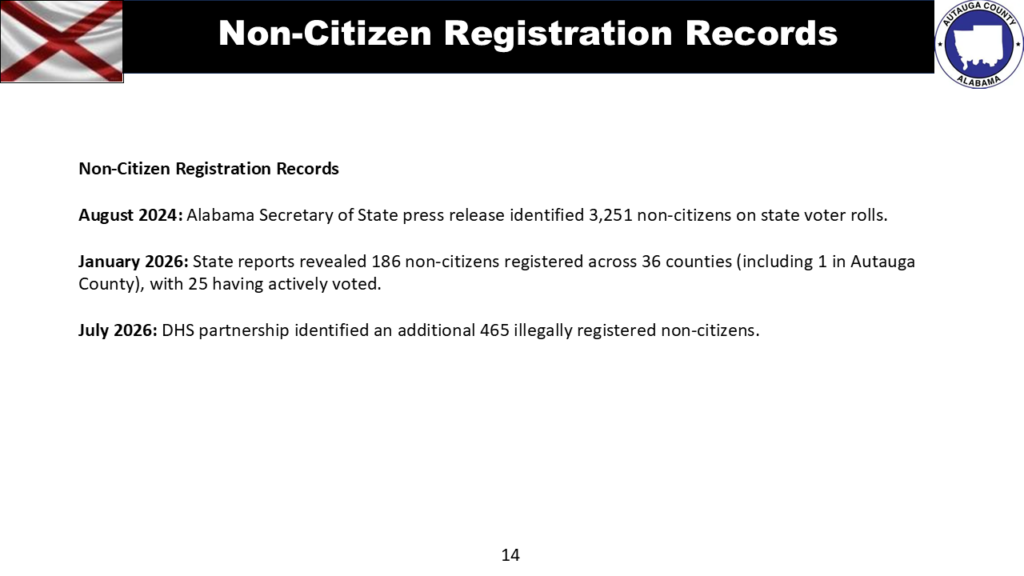
In August 2024, the Alabama Secretary of State’s Office announced that it had identified 3,251 registered voters who had been issued noncitizen identification numbers by the Department of Homeland Security. The Secretary of State’s Office said at the time that some people on that list could have subsequently become naturalized citizens and established a process for citizenship verification.
A separate federal verification effort produced another finding in January 2026. Using the Department of Homeland Security’s Systematic Alien Verification for Entitlements, or SAVE, program, the Secretary of State’s Office identified 186 noncitizens registered to vote in Alabama. Voting histories showed that 25 of the 186 had cast ballots in Alabama elections, according to the Secretary of State. The state subsequently reported that the 186 registrations were distributed across 36 counties.
One of those 186 registrations was in Autauga County.
During the Commission meeting, Chairman Jay Thompson asked Wil Sanchez about the Autauga case.
“He did not vote, but he was still on the rolls,” Wil Sanchez said.
The presentation also cited a subsequent 2026 federal cross-reference that identified another 465 records for review in Alabama.
Investigation identified 33 convicted sex offenders on active voter rolls
Herring then presented one of the team’s most serious findings.
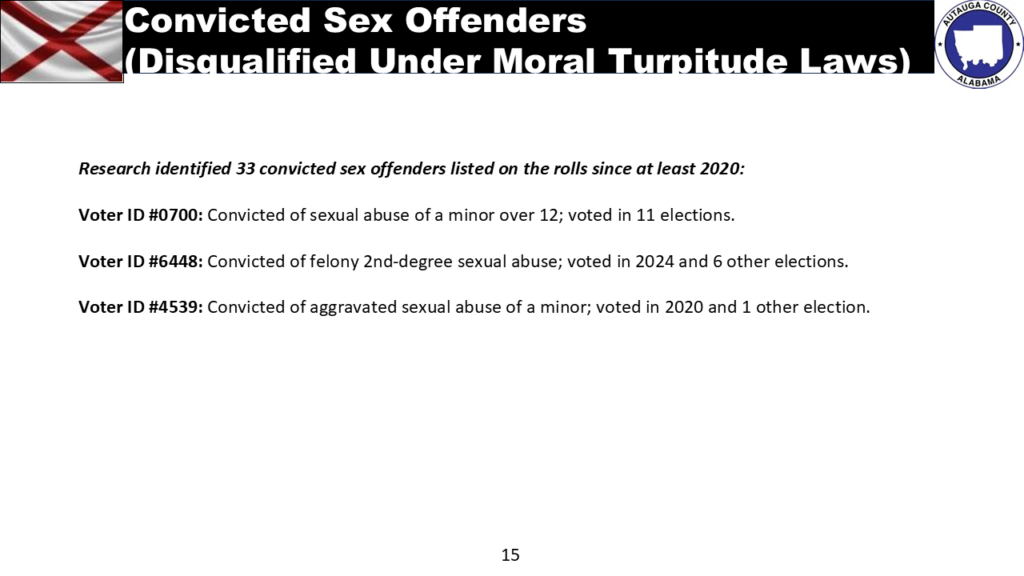
The Autauga investigation identified 33 convicted sex offenders who the investigators determined were legally disqualified from voting but appeared as active voters dating back to at least 2020. Several also had voting histories.
The investigators did not publicly display the names or complete voter-registration information during the Commission meeting. Instead, the presentation used abbreviated voter identifiers—including #0700, #6448 and #4539—to protect identifying information in a public setting.
Herring told commissioners that the team’s work involved researching criminal records and comparing those records with voter-registration and voting-history information.
The concern is not merely that an old or inaccurate name remained somewhere in a database. Where an individual is legally disqualified from voting yet remains active, the registration creates an avenue through which an ineligible vote can enter an election. Where voting history is also documented, the issue becomes more serious because the official records reflect election participation associated with that registration.
More than 40,000 voter files examined for precinct discrepancies
The team also examined more than 40,000 Autauga County voter files for residency and precinct issues.
Among the examples presented was voter #4315, whose voting history showed ballots recorded in four elections from a precinct different from the voter’s registered precinct. Another, voter #0548, showed ballots in nine elections while living outside the precinct associated with the registration.
These findings are significant because precinct assignment determines more than where a voter physically casts a ballot. It can determine which county commission district, legislative district, school board race and other local contests appear on that voter’s ballot.
The team’s investigation therefore included research into residency and physical locations rather than relying solely on the address fields contained in voter-registration data.
Team questions loss of local control
Beyond the individual voter records, Herring focused on how Alabama’s voter-registration system is administered.
She cited Alabama Code §17-3-6, which designates county registrars as judicial officers in matters pertaining to voter registration. Alabama legal materials confirm that designation and describe boards of registrars as having authority in determining whether applicants are qualified to register.
The team contrasted that local statutory responsibility with a centralized voter-registration system it identified as being hosted on an out-of-state server in Omaha, Nebraska, and managed by Election Systems & Software.
Herring told commissioners that county registrars have reported instances in which changes made locally were later reversed within the centralized system. She also raised concerns about registrars’ access to information needed to identify criminal convictions or registrations across state lines.
For the team, those issues point to a larger question: whether county officials charged with maintaining accurate voter records have sufficient control, access and auditing authority over the system containing those records.
Team asks county officials to act
Sarah Sanchez closed the presentation by bringing the individual findings back to the team’s request for county-level action.
The team asked the Commission to assert greater custodial oversight of Autauga County voter records, establish independent local auditing and take steps to protect the lawful votes of eligible county residents.
“The data has been gathered. The vulnerabilities have been documented. The legal framework is clear,” Sarah Sanchez told commissioners.
She then summarized what the team believes must happen next.
“The only thing missing is the political will to act.”
Their findings also illustrate why this Alabama election-integrity effort is focused on county-level investigation of the voter roll. The work underway in Alabama is part of a broader national grassroots movement in which citizens in counties across America are examining their own voter records and election systems at the local level. Under the guidance of Dr. Douglas G. Frank, Alabama is one part of that nationwide effort, with the county serving as the primary unit of investigation and citizen action. Every legitimate election begins with determining who is legally entitled to vote and where that person is entitled to vote. When deceased individuals remain active, noncitizens enter the registration system, legally disqualified voters remain eligible in the database, or residency and precinct records do not reflect the voter’s actual status, those failures create opportunities for ineligible votes to be included in election totals.
For legitimate voters, that is not an abstract database problem. Every ineligible ballot that enters an election has the potential to dilute the lawful ballots cast by eligible citizens.
The Autauga County team’s request to commissioners was therefore larger than correcting the individual records presented September 15. The investigators are asking county officials to address the conditions that allowed those records to exist in the first place—and to restore meaningful local oversight so the accuracy of Autauga County’s voter roll can be independently examined rather than simply assumed.