October 13, 2026
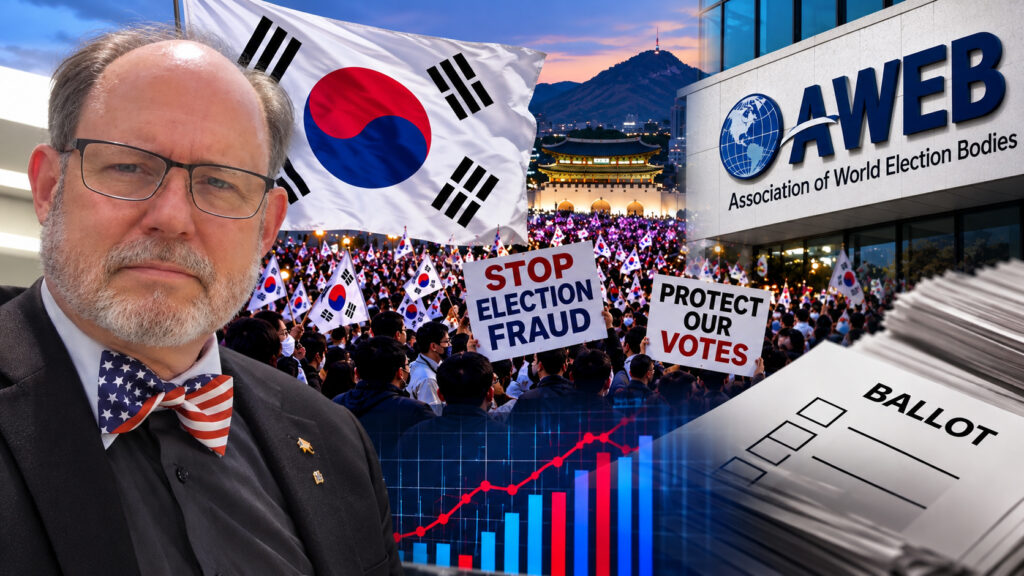
Dr. Douglas G. Frank described discrepancies in South Korea’s June 2026 elections, ballot shortages that sparked public demonstrations, and an alleged international election-fraud network operating through South Korea during an October 13 webinar hosted by Eagle Forum of Alabama.
Frank, who traveled to South Korea to assist election-integrity investigators, described how volunteers independently counted voters entering polling locations and compared those numbers with official election figures. He also presented his findings concerning the Association of World Election Bodies (A-WEB), which he believes plays a central role in international election manipulation.
Speaking with Eagle Forum of Alabama Executive Director Becky Gerritson, Frank recounted an investigation that took him from analyzing election data to witnessing confrontations between Korean citizens and election officials.
Independent Voter Counts Reveal Discrepancies
Frank’s involvement began after meeting former South Korean Prime Minister Hwang Kyo-ahn at the Conservative Political Action Conference (CPAC) in March 2026. The two subsequently coordinated election-integrity research, leading Frank to travel to South Korea with Morse Tan, a former U.S. ambassador-at-large for global criminal justice.
During early voting, approximately 350 Korean volunteers used handheld counters to record the number of people entering polling locations.
Frank’s team compared those observations with participation figures published by South Korea’s National Election Commission (NEC).
He said the investigation produced approximately 120 precinct-level comparisons, with graphs showing differences between independently observed voter counts and official ballot figures.
Frank interpreted those discrepancies as evidence of fraudulent voting activity. The investigation applied methods similar to those he has used in examining American election data, comparing independent observations and official records to identify irregularities.
Ballot Shortages Trigger Public Demonstrations
The investigation took an unexpected turn when Frank learned that a polling location had run out of ballots on election day.
Traveling with Hwang, he arrived to find voters demanding an opportunity to cast their ballots. Election officials reportedly maintained that sufficient ballots had already been supplied.
Frank encouraged the citizens to insist that eligible voters be allowed to vote, while Hwang called for greater scrutiny of the ballots and their handling.
Frank connected the shortages to the discrepancies his team had identified during early voting. He argued that fraudulent ballot activity could explain why polling locations were left without enough ballots for election-day voters.
The confrontations developed into larger demonstrations as citizens gathered outside election facilities and protested the handling of ballots.
Frank described crowds attempting to prevent disputed ballots from being transported or counted without further examination. He also showed photographs and video footage of the demonstrations, including gatherings of young Koreans concerned about their country’s political future.
The ballot shortages became a major controversy, followed by the resignation of the NEC chairman. While election authorities attributed the shortages to administrative failures, Frank maintained that his team’s findings pointed to a different explanation.
Frank Identifies A-WEB as an International Election-Fraud Concern
One of the webinar’s most significant revelations involved Frank’s investigation of A-WEB, an international association of election-management bodies headquartered in South Korea.
Frank described visiting an A-WEB facility and investigating the organization’s international activities.
He alleged that counterfeit American ballots and driver’s licenses manufactured in China had been shipped to the United States through South Korea, identifying A-WEB as the organization involved in their transportation.
Frank characterized A-WEB as the “international headquarters for the world election fraud cartel.”
He also described what he believes is the organization’s role in coordinating fraudulent ballot activity through electronic election systems.
During the webinar’s question-and-answer session, Gerritson asked about A-WEB’s connection to Alabama election data.
Frank explained that, in his assessment, A-WEB was not simply transmitting data into election systems. Instead, he alleged that it was accessing election-machine tallies and providing information that could be used to determine how many fraudulent ballots to introduce.
“AWEB is contacting the machines to find out what the tallies are and informing cheaters how many ballots to vote,” Frank stated.
He further alleged that A-WEB supplied the infrastructure necessary for those activities.
These findings formed part of Frank’s broader argument that election vulnerabilities in the United States cannot be understood without examining international election organizations, technology and communications networks.
What South Korea’s Experience Means for Alabama
Frank’s presentation connected his South Korean investigation with the grassroots election-integrity work underway across the United States.
He emphasized that examining voter rolls, ballot accounting, participation figures and election-system operations is essential to identifying irregularities and holding election officials accountable.
His experience in South Korea also demonstrated the role citizen volunteers can play in collecting independent information and challenging official election figures.
Those methods parallel the work of Alabama election-integrity teams investigating voter-registration records, residency discrepancies, voting histories and other election-related data.
The webinar concluded with a discussion of how citizens can participate in election-integrity efforts, including the work being organized through StopVotingFraudAL.com.
Frank’s central message was that election integrity depends on citizens who are willing to investigate, document their findings and demand accountability.
His complete eyewitness account, including the election-data graphs, photographs, video footage and discussion of A-WEB, can be viewed in the Eagle Forum of Alabama webinar recording above.